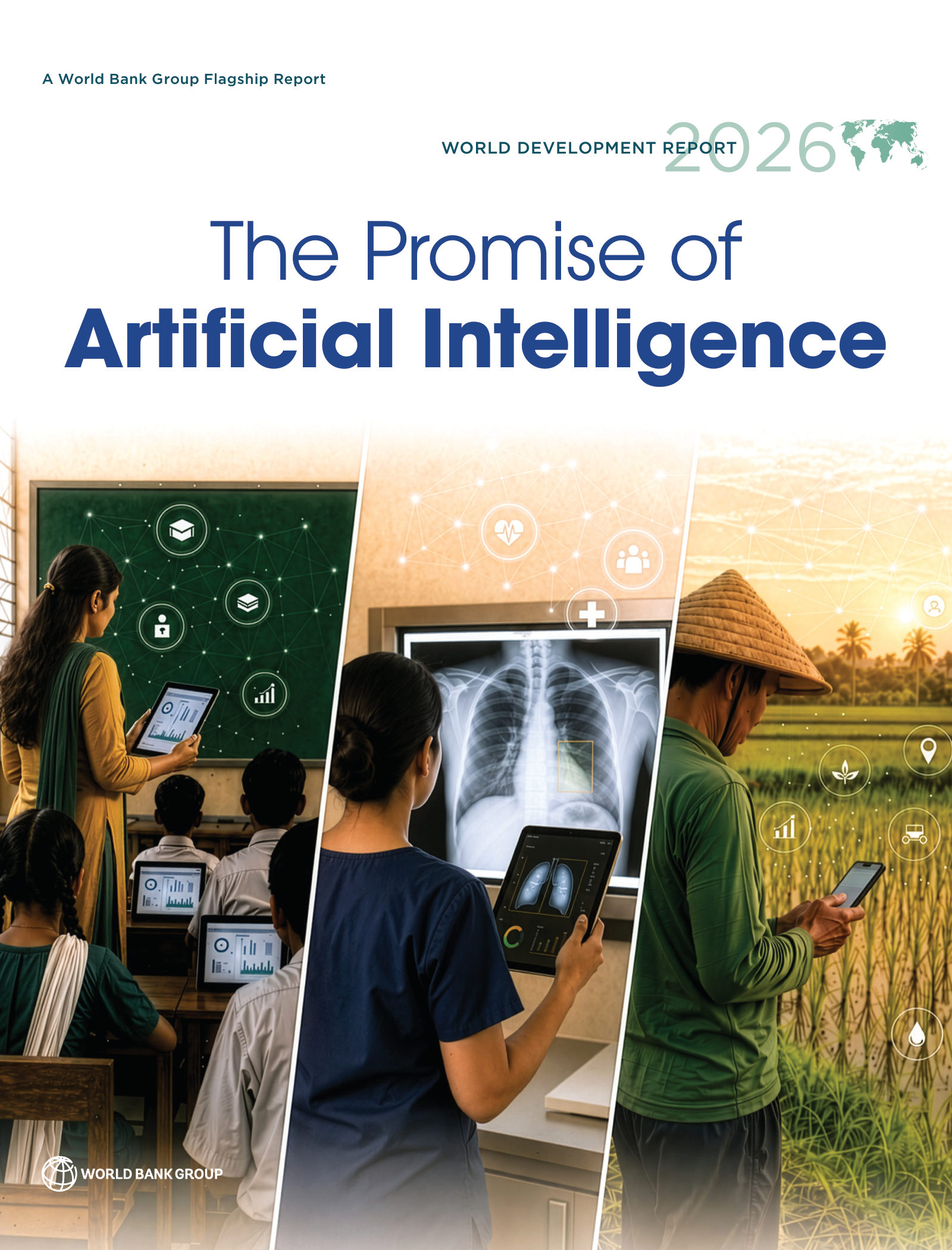
The World Development Report 2026 is out, under the title The Promise of Artificial Intelligence. I am one of its co-authors, so read what follows knowing that.
Beyond in-depth analyses of AI in developing contexts, the report brings some interesting numbers. Take this one for instance: an internet user in a high-income country is 36 times more likely to use ChatGPT than an internet user in a low-income country. Exposure to AI is only about 3 times higher. Two-thirds of the projected difference in productivity gains between rich and poor countries traces to the adoption gap, and only one-third to exposure. In other words, while the technology is reaching these economies, it is not being used in them.
The nine chapters run in three arcs. What AI can do and who controls the doing: capabilities, concentration in the value chain, and the complements – data, skills, electricity, connectivity – without which a capability lands nowhere. Then the impacts, taken one at a time: economic, social, political. Then the machinery, which is where I expect to spend most of my time here – governments as enablers, as users, and as regulators. Three different jobs, and here’s the catch: a state can be good at one while being hopeless at the other two.
There is also a four-sentence AI Disclosure Statement on page 4, naming the models used to produce the report. I have a longer piece coming about that. The interesting part is not the models.
I will write about this as I go, in pieces, rather than summarising it. It is free, and it is 380 pages.
Assorted links
- Situational Awareness goes to a fire sale – Leopold Aschenbrenner’s AI-thesis fund fell from roughly 45 to 10 billion dollars and sold its public book to Citadel at a discount, on leverage reported as high as 400 percent. Being right about a technology and being solvent in it are separate achievements.
- AI doubters and heretics have even stronger points – Francisco VH on the “Europe 2031” scenario, and the line worth stealing: the majority world enters these conversations “only as inputs: the cobalt from the DRC, the lithium from salt flats in Bolivia, the water cooling data centres in Chile, the underpaid workers in Nairobi and the Philippines labelling the data that makes the frontier possible. Never as actors with agency.”
- The how and why – OpenAI’s economic research team argue that measuring AI’s effects needs new data infrastructure. There is no number anywhere in it, which is either the point or the problem.