To measure delegability and address a conceptual gap between exposure and delegation, the authors built the Agent Delegability Index. They asked two language models to rate 18,796 task descriptions from the United States occupational database on four levels, ranging from no AI role to full delegation. The models also flagged specific barriers to automation, such as physical requirements or the need for human accountability. The authors then mapped these task ratings to 433 international occupation categories and weighted them by actual employment data across 146 countries.
The authors found that 35.2 percent of global task time can be at least partly delegated to AI agents, but only 2.5 percent can be handed over entirely. Delegable work rises steeply with national income, from 22.5 percent in low-income countries to 48.7 percent in high-income countries. This gap exists because poorer countries employ more people in physical jobs like agriculture and crafts, where the physical barrier dominates. Because the index applies United States task descriptions to the rest of the world, this transfer may hide differences in developing nations where workers use fewer digital tools. The authors demonstrated that the occupations most delegable to agents largely coincide with the ones that earlier studies identified as exposed to chatbots, meaning the new index does not create a new ranking of at-risk jobs. They also found no evidence that middle-income countries are adopting AI slower than their task base allows. The index measures only what is technically possible with October 2026 technology, not actual deployment, and the scores will change as AI agents improve.
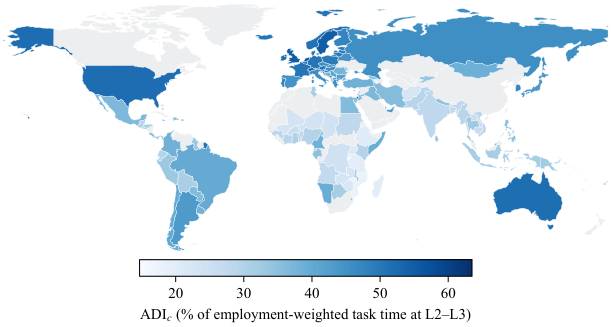 Figure from “The Delegation Divide” (Espinal Maya and Jiménez Londoño, 2026).
This piece also has a companion post: Assorted links for 22 November 2026.