To test whether interacting with a neutral AI before a group discussion improves the quality of the conversation, researchers ran a randomized experiment with 1,173 US participants across 391 three-person groups. Participants read a factual primer on a controversial policy. Before entering a 10-minute text-based group chat, participants were assigned to one of three 7-minute tasks. One group chatted with a non-directive AI programmed to ask Socratic questions about their underlying assumptions and factual knowledge. A second group wrote a solitary reflection answering the exact same prompts without AI assistance. A third control group watched an irrelevant YouTube video. The authors then measured the quality of the subsequent group chats using an automated Discourse Quality Index, which uses a language model to score messages on dimensions like justification, consensus-building, and respect for counterarguments.
Participants who chatted with the AI before deliberating produced significantly higher quality discussions than those in the other two groups. They showed positive trends toward offering more sophisticated justifications and greater respect for counterarguments, with 61.8 percent of the AI-assisted groups scoring above the median control group. However, this improvement was heavily concentrated in groups where participants actually disagreed with one another. The solitary writing exercise yielded no detectable improvements in discussion quality over a no-reflection control that watched an irrelevant video, and participants in the static reflection group reported lower policy understanding and adopted more extreme post-reflection policy stances than the control group. The authors argue that embedding brief, conversational AI reflection prompts into social media platforms could introduce productive cognitive friction into everyday digital discourse.
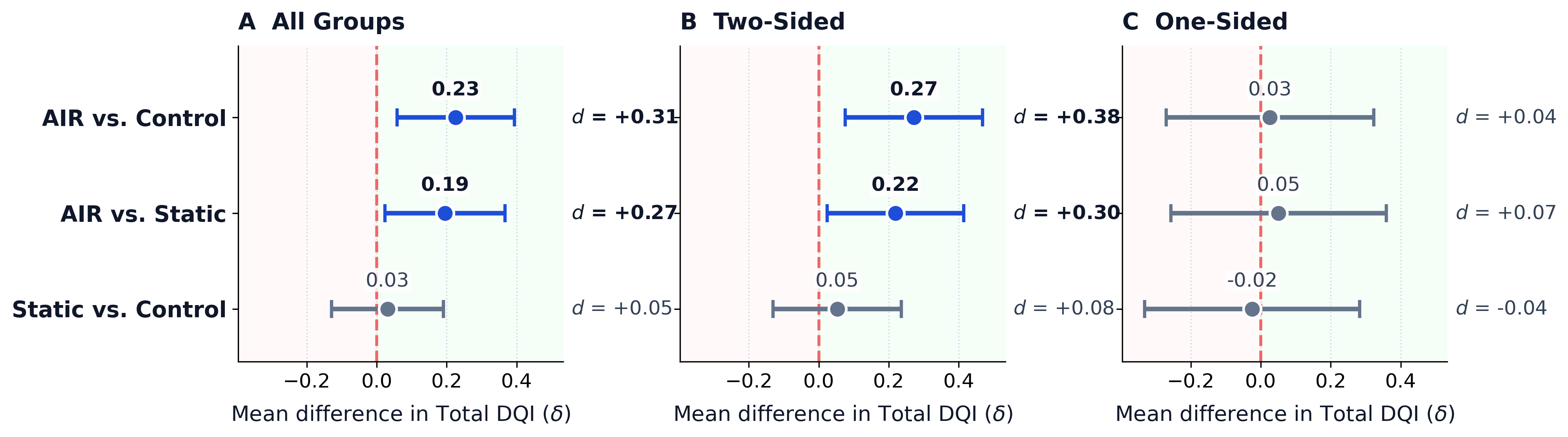 Figure 2 from Li et al., “Improving Group Deliberation through AI-Guided Self-Reflection”: the AI-reflection condition’s gains over the control and over unassisted reflection are concentrated in groups that disagreed before deliberating, and close to zero in groups that already agreed.
Today’s links: Assorted links for 3 November 2026 carries the rest of today’s haul.